Showing posts with label cocktails. Show all posts

Thursday, May 15, 2014

[Metromode] Bustin' Up the Boy's Club: Metro Detroit's Female Mixologists

Jackie Foucha at The Oakland. Photo by David Lewinski Photography for Metromode.


Last week we ran a story about the rise of craft cocktail culture in metro Detroit and some of the key players who have pushed it forward. While forward-drinking female bartenders Lola Gegovic, Jacqueline Foucha, and Adrianne Martin were all name-dropped, the focus was all on the boys in the business. Through conversations with people interviewed for that story, it became glaringly obvious that female bartenders in metro Detroit get none of the press that their male counterparts do.

Read more.

Thursday, May 8, 2014

[Metromode] The Rise of Metro Detroit's Mixologists

Shane McGrath at The Oakland. Photo by David Lewinski Photography for Metromode. 


Maybe it's because of metro Detroit's automotive history, but whenever a new trend hits we have a tendency to take it from zero to 60 with ear-splitting speed. We did it with food trucks. We did it with pop-ups. We did it with coffee and craft beer and artisan spirits. And we did it with craft cocktails.

Read more.

Monday, September 30, 2013

[EID Feature] Chef Paul Grosz takes a Stand

Photo by Nicole Rupersburg.


The Stand in Birmingham officially opens for business today. The hotly-anticipated restaurant taking over the former Zazio's space - a concept that rather majestically flamed out for any number of reasons up to and including a cumbersome, poorly-planned space draped in seizure-inducing swirls of neon and food that quite simply wasn't that good (even by Birmingham's notoriously mediocre standards) - is a partnership between Chef Paul Grosz of Cuisine and fine dining industry vet John Kelly with Greenleaf Trust/Catalyst Development, owners of the building, as the investors.

Chef Paul is the Executive Chef of this new concept, and he'll also continue overseeing Cuisine in New Center, running back and forth between both. I've know Chef Paul for a few years - he was one of the first chefs I really established a personal rapport with back during my early days as a scrappy blogger - and, knowing him as well as knowing the difficulty of taking on such a massive space and making enough money on it for the business to stay open, my first question to him was: are you insane?


The answer is yes but in a way that makes sense in the long term. Paul has a 10-year plan. Part of that 10-year plan includes positioning himself for retirement and being able to put his mark on something other than Cuisine - a restaurant he is very proud of and happy with, but one that is also very much events-driven given its somewhat isolated location in New Center across from the Fisher Building.

Paul is also considering the natural trajectory of the chef's career. As he is currently filling in for Mr. Charcuterie Chef Brian Polcyn at Schoolcraft, teaching Polcyn's charcuterie class while Polcyn is busy working on his latest endeavors, Paul is thinking more and more of following in Polcyn's footsteps and transitioning into the role of instructor. He'd like to teach more at Schoolcraft - not Polcyn's class, but possibly a new class on seafood, which receives little attention as part of the school's culinary instruction, and maybe even vegetarian and vegan cuisine. (Paul is big on seafood, and also on veggies, as you'll find on the menu at the Stand). He'd also like to mentor up-and-coming chefs and eventually get out of the kitchen entirely.

Chef Paul in the kitchen. 

But that's all part of the 10-year plan. For now, Paul is going to be in BOTH kitchens, overseeing all operations and doing the cooking himself along with the help of his culinary team.

The menu at the Stand is decidedly small and carefully-managed. Items include a lobster fried egg - a brioche-breaded soft-boiled egg with lobster and asparagus - duck confit cassoulet, rabbit, and waygu beef, with a purposeful emphasis on sea food. (Again, this is Paul's thing.) There is a charcuterie room in which they will cure and dry their own meats (which will also be supplied to Cuisine) that should be fully operational in the next month. And while that all sounds like a very protein-centric menu, vegetarians and vegans can take heart: YOU HAVE YOUR OWN MENU. Eight entirely-vegan items are highlighted on their own menu, so you don't just have to order whatever lame-o salad or soup made vegan as an afterthought.


The bar area comes with its own menu and includes things like veal sweetbreads, foie gras burgers, duck sliders, and daily oysters. And desserts will be just as special as the rest of the menu: Pastry Chef Kevin Kearney, who has worked with Paul at Cuisine for years, is now at the Stand making his unique creations like goat cheese cheesecake and funky ice cream flavors (he did it before it was cool). He is one of the finest pastry chefs in the area, so do be sure not to skip dessert.

The beverage program is just as thoughtful, with a small but solid selection of Michigan craft beers and an entire craft cocktail program designed by none other than Travis Fourmont.

The Hall of Culinary Fun.

Those of you who remember Zazio's Wizard of Oz-on-acid color scheme (an image surely burned into your brain if you ever stepped foot in the place), all I can say is...wow. The space is transformed. And by that I mean they COMPLETELY gutted it - like, everything. Like, they kept nothing. They scrapped everything short of actually bulldozing the building. The entrance is now on Peabody and diners will be greeting in the "lobby" before heading down what Paul calls the Hall of Culinary Fun. To the right, you will see the open kitchen with a 10-seat bar where they will host two degustation menu seatings per night (in lieu of actually having a "chef's table" in the kitchen). To the left is the separate bar area with comfy booths and a community table. Further down is the main dining room and three private dining rooms.

Hand-blown glass gourds from Epiphany Glass.

As you walk around the massive space, take note to pay attention to the design details. Wood for the bars, ceilings, the communal tables and booth backsplashes is all reclaimed wood sourced through the WARM Training Center in Detroit, much of it from deconstructed homes in Detroit and Hamtramck. Eric Gorges of Voodoo Choppers made custom metal art pieces, including a copper "replica" of the Mackinaw Bridge over the communal table in the bar. In the main dining room, a series of four hand-blown glass sculptures made by April Wagner of Epiphany Glass represent the four seasons of food - leeks in the spring, shellfish in the summer, squash in the fall, and ice wine in the winter. Janelle Songer made the ceramic pieces throughout the restaurant. It was very important to both Paul and John to make this a space that is a reflection of the community, using local artists and salvaged materials with roots in metro Detroit. They want this to be a place that appeals to everyone, to have construction workers sitting next to bankers and everyone be comfortable. Like at a lemonade stand, where everyone has the same experience regardless of who and what they are - hence the name.


In regards to my question of how they were going to break up this 10,000-square-foot space to maximize marketability and monetization (something else Zazio's struggled with), the three private dining rooms are the answer. The 14-seat communal table inside the wine cellar is one, perfect for private celebrations. The 10-seat Paul W. Smith room is intended for celebrities and high-ranking executives, and even has its own private entrance. The third is a 40-seat conference room wired for all AV equipment with a large TV for teleconferences, and this is the space with the most potential to bring in a steady stream of business business.


Part of Paul's 10-year plan includes possibly opening more Stands in other areas in metro Detroit, or working with John on another concept in Birmingham - seafood, perhaps? But he's got 10 years to figure that out. For now, he's focused on getting the Stand open, which quite possibly stands to be the best restaurant in Birmingham.

The Stand has already been operating for a few weeks, hosting private events and seminars. It opens to the public officially at 5 p.m. today and will be open 5-10 p.m. Monday through Thursday and 5-11 Fridays and Saturdays (closed Sundays). Eventually they will also be open for lunch.

Want to see more? View the Flickr set here

Tuesday, September 24, 2013

[Metromode] Distilling the Greatness of Michigan-Made Spirits

Photo by Nicole Rupersburg.


Thanks to the growth in the craft beer industry and craft cocktail culture, the craft distilling industry has been growing exponentially in recent years, from barely two dozen microdistillers across the country in 2000 to over 250 in 2012, with dozens more currently seeking federal licensing. Michigan alone has over 30 licensed craft distillers with more in the works, including several in metro Detroit. There is also a Michigan Distillers Guild in the early planning stages, mirroring itself after the Michigan Brewers Guild to be an advocacy group for Michigan's microdistillers.

Read more.

Wednesday, September 18, 2013

[Real Detroit] Public House

Photo by Nicole Rupersburg.


You know how much we love Imperial? (That's a rhetorical question. We all love Imperial a lot.) What if we told you that the people who brought us Imperial were getting ready to open a new spot in downtown Ferndale called Public House, and that it will be exactly like Imperial but completely different and equally awesome?

That's something to get excited about, right?

(Again, that's a rhetorical question. But yes.)

Read more.

Friday, September 13, 2013

[Real Detroit] Urban Cellars

Photo by Nicole Rupersburg.


In the last couple of years, craft cocktail culture has exploded in metro Detroit. We went from just a handful of restaurants with an exceptional selection of craft cocktails both classic and those created in-house that only those who REALLY knew would really appreciate, to dozens of cocktail-focused bars and restaurants from Ann Arbor to White Lake that emphasize fresh, house-made ingredients and artisan spirits on their drink menus.

Urban Cellars is now open inside the newly-renovated Crowne Plaza Pontchartrain Detroit located across the street from COBO Center. The common areas of the hotel have gone through a serious remodeling, including the lobby and the hotel's main restaurant and lounge located on the lobby level. The restaurant is the Jefferson House, led by ambitious up-and-coming Executive Chef Justin Vaiciunas, who is also the hotel's director of food and beverage overseeing the full dining program.

Read more.

Monday, September 9, 2013

[EID Preview] Two James Distillery

All photos by Nicole Rupersburg.


The newly-opened Two James Spirits in Corktown is the first licensed distillery in the city of Detroit since before Prohibition (it won't be alone in that sandbox for long though; Detroit City Distillery will open in Eastern Market sometime in 2014).

The distillery was founded by Peter Bailey and David Landrum; third partner Andy Mohr came on board later. They purchased a large industrial building on Michigan Avenue on the other side of Roosevelt Park from Slows et.al. last July. Renovations on the 7,000-square-foot building, which was previously a taxi cab storage and dispatch center and originally a doughnut manufacturing plant when it was built at the turn of the century, took a full year to complete.

But the work is done, and Two James is already welcoming their first customers in a super soft opening, allowing them to get their feet wet as you wet your whistle, as it were.

Bailey and Mohr. 

The space is a production facility for their Two James label spirits, which includes 28 Island Vodka, named for the 28 islands (some now underwater) in the Detroit River which were used as hideouts during Prohibition; Old Cockney Gin, a London-style dry gin created to honor Bailey's father, a Brit; and Grass Widow Bourbon, named after an old whiskey brand once manufactured in Detroit, which was once a leader in premium whiskey manufacturing. There is also a 100% rye whiskey, another bourbon, and a reserve single malt whiskey (these all need to age in barrels and won't be released for at least a year). Future plans also include Two James Calvados and Two James Absinthe. They try to use as many local products as possible; the rye for the 100% rye whiskey all came from a farm in Jasper, Michigan, and they also plan on making some eaux di vies with local fruits in the future (like an apple brandy).


Bailey and Landrum took a distilling class together in Chicago. After long considering opening his own restaurant, it became more and more clear to Landrum - who was already really into craft cocktails and was already making his own bitters and cocktail recipes at Cafe Felix in Ann Arbor - that it was possible to make a really high-quality product locally and have a sustainable business. The two forged a business partnership and after considering different parts of the country for the distillery, eventually decided that Detroit city is the place to be. Mohr says local businesses like Slows and Sugar House have been exceedingly supportive.

Two James is named after the founding partners' fathers, both deceased (and both named James). The name is their tribute to the values of hard work and the importance of family instilled in them by their fathers.


Two James products are available for purchase in their tasting room and are also now hitting the shelves of stores and local bars through their distributor Great Lakes Wine and Spirits. Distribution will start in Michigan and eventually expand out to the Midwest and East Coast with hopes of breaking into international markets. Their 500-gallon copper still can produce a lot of booze; for their first year of production they are looking at 2,500-5,000 cases and can grow from there.

The quality of their products doesn't just stop at what's inside the bottle: the bottles themselves are works of art. The packaging for their vodka and gin was designed by New York-based Stranger + Stranger, which specializes in packaging design for wine, spirits, and beer. The bottles feature the words "Corktown" molded into the base of the bottle and "Two James Spirits" on top, a coin with the Two James branding fused into the bottle, and exquisitely detailed labels modeled after pre-Prohibition marketing pieces. This packaging without a doubt has a few design awards in its future.


That attention to detail and quality of design work has also been carried into the tasting room. Architect Piotr Kolacz designed the space. Bricks are either original to the building or reclaimed from other historic buildings. The original steel beam overhead was simply repainted, and the garage door in front was replaced with a glass one. Wood for the floors and benches came from Reclaim Detroit. A massive circular concrete bar designed by Kolacz was framed and poured on-site: this thing, all one piece, will NEVER leave this building. It will be one of the only things left standing after humanity blows itself up and all that's left is rubble, cockroaches, and this bar.


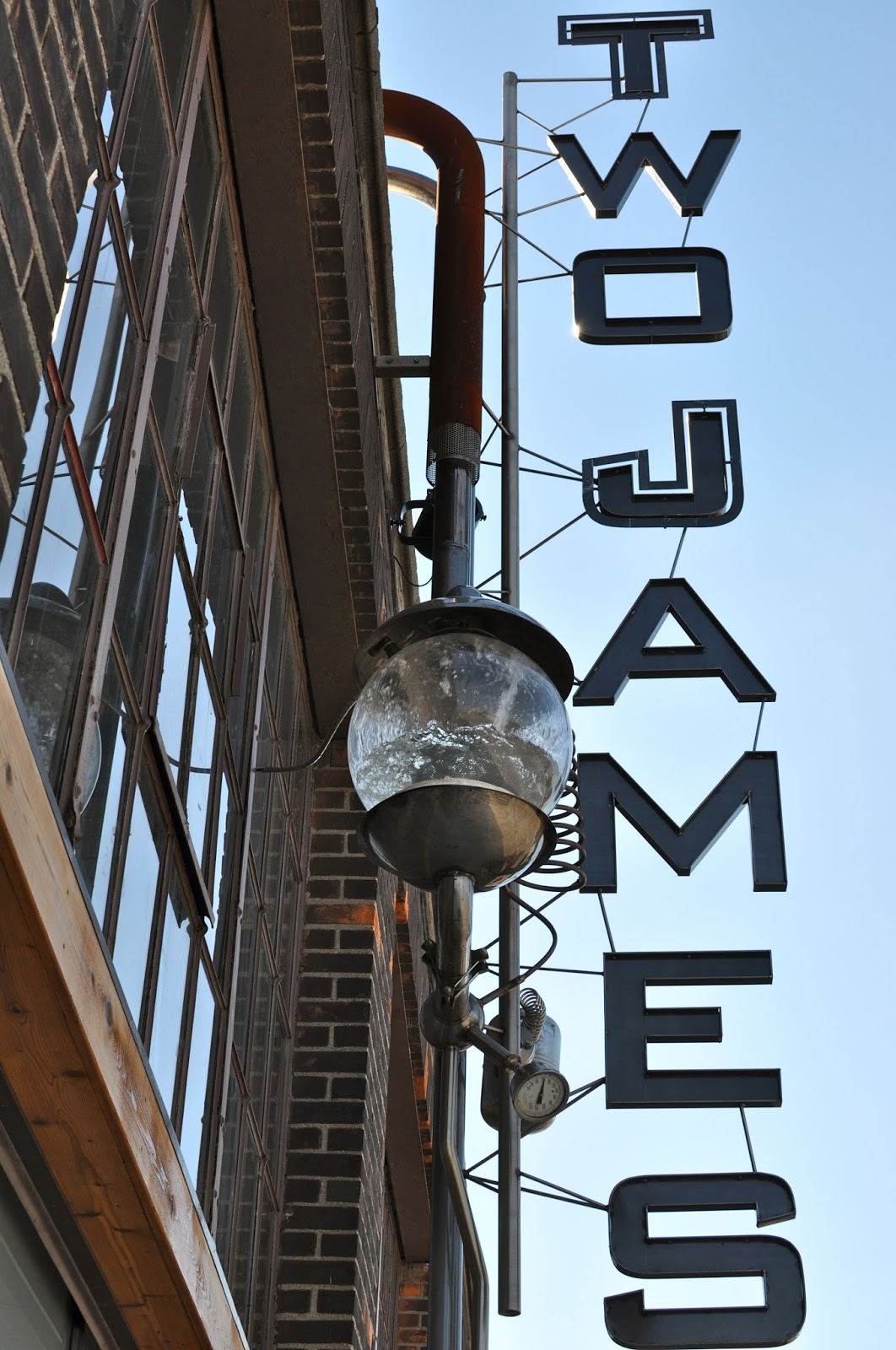
Overhead is a circular steel ring with metal globes hanging from it. The globes came from a bazaar in Egypt that Kolacz came across while traveling; the welding of the steel ring and the decidedly steampunk Two James sign out front was done by metalworker Taru Lahti. Inside they will also hang works from local artists for sale (100% of sales go to the artist) and they also have a projection which can only mean one thing: movie nights!

Two James is now open for limited hours with a limited cocktail menu featuring their spirits. Landrum is currently out of the business (his wife just had a baby), so look for the grand opening in the next month with regular hours and a more extensive cocktail menu with fresh ingredients from Eastern Market and and house-made items like vodka infusions with yellow raisins and Afghan figs. Hours will be Thursday, Friday and Saturday evenings to start as they gauge demand.

An unofficial opening last month with the Oily Souls Motorcycle Club showed them that demand could in fact be quite high - about 1,000 people came out, many in no way affiliated with the bike club but came only because they saw something was happening over at the new distillery. Next spring the back lot, now covered in gravel, will be transformed into a patio and event space with the dramatic Michigan Central Station as its backdrop.

Want to see more? View the Flickr set here

Thursday, June 27, 2013

[HOT LIST] Cocktails

Dave Kwiatkowski of the Sugar House. All photos by Nicole Rupersburg.


It goes without saying that the BEST best places in metro Detroit to get a craft cocktail are Roast, the Oakland, and the Sugar House (which was just named one of the best bars in America by Playboy). But as the trend has grown over the last couple of years - so much so that Michigan Radio recently took notice and ran a state-wide poll looking for Michigan's best craft cocktail bar, and Michigan State University has their own Artisan Distilling Program (the Master Distiller of Death's Door is a graduate of this program) - an ever-increasing number of bars and restaurants are getting with the craft cocktail program. And not in the half-assed way they did before (changing the name of their martini menu to "craft cocktails," yet keeping all the same candy-flavored vodka drinks) - this time it's in earnest. Top-shelf spirits (think bourbons, gins, and boutique liqueurs), fresh-squeezed juices, and house-made bitters and infusions separate the men from the martinis. What a difference two years make, eh? These are some of the best places to get some (aside from Roast, the Oakland, and the Sugar House, of course).

#1 Pizzeria Biga Royal Oak, Southfield, Ann Arbor (opening soon)
Pizza and craft cocktails? Absolutely, when the pizza in question is made by James Beard award-nominated chef Luciano del Signore (along with house-made charcuterie) and the cocktails by some of the best local bartenders in the business. Biga's beverage program in general is a thing of excellence, with proper dues given to its Italian inspiration in its selection of Italian beers, wines, and liqueurs. They also have a great selection of craft beers and have recently started hosting beer dinners. As for cocktails, they have a full selection of classic craft cocktails as well as some of their own creations.

Red Crown. 
#2 Red Crown Grosse Pointe Park
Turns out, Grosse Pointers are a bunch of booze-hounds. (This probably surprises no one who is familiar with Grosse Pointers and their lifestyles.) Mixologist Thomas Phillips, a self-described liquor nerd, leads the bar's cocktail program, which includes a mix of classic cocktails and his own creations, which he changes seasonally. The renovated historic gas station in Grosse Pointe Park opened earlier this year and was an instant hit with the community that has been woefully underserved in their demand for drink. This summer, enjoy their expansive, beautifully-landscaped patio with a cold cocktail and some smoked meat and Southern-style comfort food.

#3 The Last Word Ann Arbor
The Last Word takes its name from the classic cocktail of the same name, which is fitting for this Prohibition-era craft cocktail bar. This place is all about the booze, and be sure to shop in for Whiskey Wednesdays when they serve Scotch (SCOTCH SCOTCH SCOTCHY SCOTCH), bourbon and rye half-off. It's a classy joint in a college town, and their cocktails are on point.

#4 Bailout Productions Detroit
We all know that Roast is one of the best places to go for a craft cocktail, and that's because of the talent behind the bar. Bailout Productions has its roots in Roast, where founders Travis Fourmont (who now works at Great Lakes Wine and Spirits) and Joe Robinson (still holding down the happy hour fort) both worked. They now team up for pop-up bar events at places like Green Dot Stables and the currently-uninhabited Rhino Club in Harmonie Park, and bring their full cocktailing skills along with some friends – like chef Andy Hollyday, who recently left his post at Roast to work on opening his own restaurant in Midtown. They've got more events planned for this summer, so be sure to follow them on Facebook for updates on their upcoming pop-ups.

#5 Sardine Room Plymouth
The much-buzzed-about Sardine Room in Plymouth just celebrated its one-year anniversary earlier this month. Known for their selection of fresh seafood (oysters, the oysters, especially the oysters) and elevated small plates, the Sardine Room also has an excellent selection of craft beer and craft cocktails. What with all of the oysters and the hot sauce and the lobster rolls (basically a lobster po'boy) and the shrimp and grits, the Sardine Room has a vaguely New Orleansean vibe, so it seems only fitting to sip on a Sazerac (the drink that originated in the Big Easy over 150 years ago) while you're here.

Bubbling under Valentine Distillery (Ferndale), Gastronomy (Southfield), Zingerman's Roadhouse (Ann Arbor), St. Cece's Pub (Corktown), Vellum (Ann Arbor), Great Lakes Coffee (Midtown), Union Woodshop (Clarkston), the Raven's Club (Ann Arbor), Imperial (Ferndale), the Bar at 327 Braun Court (Ann Arbor), the Laundry (Fenton), the Root (White Lake), Torino (Ferndale), Lena (Ann Arbor)

Tuesday, April 9, 2013

[NEWS BITES] Travis Fourmont leaving Roast, joining Great Lakes Wine and Spirits

Mr. Manhattan himself, Travis Fourmont


Travis Fourmont, one of the friendly faces behind the bar at Roast and also one of the top bartenders in the country, is leaving his position at Roast to join Great Lakes Wine and Spirits, the Highland Park-based wine and liquor distribution company.

Great Lakes, the end result of the 2007 merger between General Wine and Liquor and J. Lewis Cooper, is the largest distribution company in Michigan and is getting bigger. They currently employ about 900 people all over the state and want to further expand their offerings and services (which includes not-yet-official plans to acquire a Michigan beer distributor and get back into beer distribution).

Travis is joining the team as the corporate mixologist, a brand-new position being created so that Great Lakes can keep its competitive edge on the market, following the lead of major national distributors like Southern Wine and Spirits, which also employs a corporate mixologist.

His position is more akin to being a consultant for Great Lakes accounts. His role will include anything from collaborating on craft cocktail programs at bars and restaurants to assisting bars in keeping down liquor costs and product consultation. For Great Lakes accounts, his services come free.

Great Lakes also carries many of the top shelf spirits he is accustomed to working with, like Woodford Reserve and Bombay Sapphire, both of which he has won competitions using -- Travis makes the best Manhattan in the country according to Woodford Reserve, and also placed in the top 10 as well as winning the audience choice award at a Bombay Sapphire competition in Las Vegas last year.

Also joining the Great Lakes team is Antoine Przekop, a big name in the local liquor industry who has worked as a general manager and sommelier at places like Tribute and SaltWater and is considered one of the local authorities on wine and spirits. Antoine, who just passed the Certified Wine Educators (CWE) exam and is in the process of completing this certification (which no one else in Michigan has), will come on board on the sales side, working with top-shelf and boutique spirits. This is his first job working in sales for a distributor and outside of the restaurant industry. After 15 years on the customer service end, he welcomes this professional change and the ability to focus more on sales and portfolio development, his particular strengths.

Snagging these two well-known and well-respected names in the local beverage industry is a major coup for Great Lakes and a boon for their long-term growth plans.

In the meantime, Roast's cocktail program will remain just as strong as ever. They are rolling out a new spring cocktail menu, which was mostly hands-off for Travis, and from the three (*gulp*) I've tried so far there is no reason to mourn Travis's departure other than for the fact that we'll miss his smiling face. Check out the full new cocktail menu below. Travis's last days at Roast are Wednesday and Thursday this week; stop by to wish him well and have one last award-winning Manhattan.

Roast's Spring Cocktail Menu (with thanks to Roast's Joe Rob for providing)

Awww Snap
Sugar Snap Pea Infused Gin, Cocchi Americano, Fresh Lemon, Simple Sugar, Mint, Celery Bitters, Crushed Ice, Pea Tendril

The Last Straw (like strawberry lemonade!)
Sugar Snap Pea Infused Gin, Strawberry Infused Chartreuse, St. Germaine, Fresh Lime, Strawberry Garnish

Green Machine
Muddled Avocado, Ilegal Joven Mezcal, Spiced Agave Syrup, Fresh Lime, Cracked Black Pepper

Turnin’ on the Screw
Citadelle Gin, Aperol, Fresh Lemon, Rhubarb Bitters

Phosphene Dream
Mindo Cocoa Tea Infused Bourbon, Averna Amaro, Orange Flower Water, Xocolatl Mole Bitters, Mezcal Rinse

Self Portrait in a Convex Mirror (hello super-awesome beer cocktail)
Bulleit Rye, Crème De Cassis, Fresh Lemon, Egg White, Petrus Aged Pale

Je Ne Sais Pas
Ron Zacapa 23, Fresh Lemon, Simple Syrup, Mint, Xocolatle Mole Bitters, Egg

The Mazatlan (HOLY SHIT - order this by the pitcher)
Cilantro Infused Gin, Jalapeno Syrup, Fresh Lime, Chili Oil, Sea Salt

Bar Fly
Fig Infused Gin, Campari, Cherry Heering, Cranberry, Angostura, Vanilla Fig

Cucumber Collins
Cucumber Infused Gin, Fresh Lime, Simple Sugar, Soda

PRCPU
Old Overholt Rye, Fernet Branca, Tawny Port, Aperol

Tuesday, March 26, 2013

[Model D] SkyBar and Lounge now open on 33rd floor, previous ground floor space being renovated and expanded

Photo from SkyBar's Facebook page.


Up until a couple of weeks ago, "Sky Bar" was a bit of a misnomer, what with the bar and lounge being located on the ground floor of the David Stott Building in downtown Detroit.

"We are in the process of a rebranding," says Marshal Simons of Impakt Digital, community manager of SkyBar and Lounge. "When the owners first opened they were new at the bar industry and wanted to get in on the ground level of Detroit" … so to speak.

Read more.

Friday, December 14, 2012

[HOT LIST] Spanish coffee

Spanish coffee. Photo source: The Internet.
The Spanish coffee is one of those holdover dessert drinks from the Reagan Era of steakhouse sovereignty. While once the grande dames of dining, these places are now mostly houses of old people food (though the "classic" steakhouse certainly seems to be coming back into vogue as of late). While other dessert drinks (like the ice cream-based Hummer) have been mostly relegated to the realm of revived steakhouses and horrible national chains with apostrophes in their names, the Spanish coffee has managed to attain a certain level of credibility, even amongst the craft cocktail crowd. Part nouveau trendy, part nostalgic throwback, the Spanish coffee is simply a lovely winter warmer and always will be. The places you'll find it are as varied as the recipes they use, but certain things are consistent: coffee, whipped cream, sugar rim, booze (usually coffee liqueur, brandy, rum, or any combination thereof).

#1 Tom's Oyster Bar (Royal Oak)
The secret to an excellent Spanish coffee is Tia Maria, a vanilla-infused Jamaican coffee liqueur. For many years, Tom's was widely renowned across metro Detroit for having the best Spanish coffee EVAH. This was because of Tia Maria. Then Tia Maria was suddenly and inexplicably unavailable in Michigan for a hot second (sometime in/around 2010-ish), and people took notice: Tom's Spanish coffee simply wasn't what it used to be. But then! Tia Maria just as suddenly and inexplicably became available in Michigan again (because the MLCC is awesome and is obviously a rational and consistent entity) and now Tom's Spanish coffee is just as awesome as ever. And not just because they set it on fire. But a little bit because of that.

#2 London Chop House (Detroit)
This is one of those recently-revived steakhouses of sovereignty but done so impeccably well (provided one can appreciate such painstaking throwback) that you just have to sit back (in the plush red leather booths) and enjoy the point at which historic preservation, well-funded nostalgia, museum-like reverence, and unapologetically untrendy classic steakhouse cuisine collide. The Spanish coffee is about half rich, creamy homemade whipped cream and half booze with a dash of coffee for warmth and color. With a lounge singer crooning hits from the Great American Songbook and a belly full of oysters and steak and starch and heavy cream sauces, it's hard not to get into the spirit of the place. The Spanish coffee is a perfect ending to a meal that is, by necessity, already over the top (and there's probably enough calories in that whipped cream alone to fully replace an actual dessert). They also serve that classic Hummer concoction, which they made famous back in the diz.

#3 The Emory (Ferndale)
They're not really known for their Spanish coffee, but they should be. Known best as a beer and burger bar (REALLY good beer and REALLY good burgers, and a build your own Bloody Mary bar on Sundays), their Spanish coffee is a local best kept secret. But if you're hanging out there one day and you see a blue flame and sparks emanating from behind the bar, that's their Spanish coffee - they light the brandy on fire and then spark it with cinnamon. Topped with rich whipped cream and a maraschino cherry, you totally won't feel like a wuss for ordering this because (a) fire, and (b) hipster bar. (Probably it's ironic?)

#4 Torino Espresso Bar (Ferndale)
Their Spanish coffee recipe is modeled after Tom's, right down to the orange twist, though it feels like it makes more sense here being that this is a cocktail bar with an emphasis on coffee and not a seafood house with an emphasis on oysters.

#5 Bacco Ristorante (Southfield)
Italian, Spanish, whatevs, there are no boundaries here. At Bacco you get a bowl of Spanish coffee to enjoy on its own (it's enough) or with one of their house-made pastries or gelato.

Bubbling under The Hill Seafood + Chophouse (Grosse Pointe), Santorini Estiatorio (Greektown), Clawson Steakhouse (Clawson), Terry's Terrace (Harrison Twp.), Fishbone's (Greektown, Southfield, St. Clair Shores)

 Tom's Oyster Bar on Urbanspoon

Sunday, November 25, 2012

[Real Detroit Weekly] Six Drink Slam: Imperial

Ring of Fire. Photo by Nicole Rupersburg.


Imperial, the L.A. hipster crustpunk biker rockabilly whisky bar and taco shack in Ferndale, is pretty much one of our new favorite places ever. Tacos? Good. Beer? Good. Booze? GOOD. To prepare for this round of Six Drink Slam, we laid down a basecoat of their house-made biscuits and chorizo gravy during their recently-launched Sunday brunch. What's that you say about Sunday Funday? We bet ours was funner than yours.

Uno Mas
"Uno mas" means "one more" in Spanish, and is the thing to say when you're at the bar and your friends are trying to drag you out or you're trying to convince yourself to leave because it's Tuesday and you still have to work the next three mornings. "Uno mas!" When you make that "just one more" promise to yourself, all is well in the world and time has no meaning and morning won't come early. This is that in drink form. Made with reposado tequila, cucumber, agave, Cointreau and lime, this one makes it easy to get a case of the just-one-mores.

Ring of Fire
Johnny Cash is something of a mascot at Imperial. Johnny Cash wrote a song called "Ring of Fire." "Ring of Fire" was used in a hemorrhoid commercial. Do you see where I'm going with this? "I'm afraid that drink is going to rip me a new hole," commented a co-slammer. He wasn't wrong, but we took one for the RDW team so that we could have money to buy some of that really nice, soft Charmin toilet paper with the aloe vera lotion. Imperial's Ring of Fire is made with their house-made habanero-orange infused tequila and grapefruit. In case you're not good with analogies, it's fairly fucking spicy.

Lavender Sidecar
Ooooh, bourbon! That's a good thing to chase habanero tequila with. As much as Imperial has that whole Mexi-Cali thing going on and so far we've been all about tequila, their L.A. rockabilly hipster roots are on display with their equally impressive selection of brown liquors. The Lavender Sidecar is made with bourbon, beautiful bourbon, Cointreau, house lavender honey syrup, and lemon. It tastes like tea! But with BOURBON.

Sunset Strip
Going a little off-menu, co-owner Jeff King brought us a Sunset Strip, one of their fall special drinks made with Limoncello, hard cider and house saffron syrup. Another co-slammer laid claim to this one pretty quickly, sucking it down while forcing the rest of us to soldier through the Ring of Fire offset by the Lavendar Sidecar. "It's light and refreshing and tastes like lemonade!" Asshole.

Louisa
Pucker up for a kiss from lady Louisa! Which is more like a punch. That you don't even realize happened until it's too late. This is the one vodka drink on their menu and is made with their house-infused rosemary mango vodka, St. Germaine and lemon. Served in a martini glass, it certainly LOOKS the most foo-foo of the bunch. But vodka is just as strong as bourbon and this thing is straight booze. Actually, pretty much all of these are straight booze. "These are all, like, REALLY strong," observed a cohort. Indeed.

Detroit Tart
Made with silver tequila, tart cherry juice and lime with a sugar salt rim, it's hard to say what might be distinctly "Detroit" about this, but it's delicious so why quibble. For the record, THIS is the most foo-foo drink on the menu. Which should really just go to show you that there really aren't any foo-foo drinks here. Imperial is a place for drinking professionals.

Read more.

Friday, October 19, 2012

[EID Feature] Sexy Time in Ann Arbor: Lena + Habana

All photos by Nicole Rupersburg.

Two of my favorite people in restaurateuring (actually, it would probably be safe to say that these guys ARE my two favorite restaurateurs, the end) have opened yet another business in Ann Arbor (two, really) and it looks like they've got yet another winner(s) under their belts.

Greg Lobdell and Jon Carlson of 2Mission Design and Development have been on a tear here, there and everywhere. Jolly Pumpkin is expanding their Dexter brewing facilities (so Ron Jeffries can keep brewing unicorn tears and more of it) and they'll be opening a third Jolly Pumpkin Cafe soon (this one in Royal Oak). Together they own more than a dozen restaurants and bars in Royal Oak, Ann Arbor and Traverse City, and they're not slowing down any time soon.


Meet Lena (Lay-na), the team's newest venture and Ann Arbor's latest in cosmopolitan Latin-fusion cuisine. The place is total sexy time with a stripped-down aesthetic and an emphasis on clean, curved lines. From the Jetsons-inspired ceiling-mounted fireplace (get your own for a mere $8,500) to the curved wall and sparse west coast palette (save for the very very green exterior), this place just oozes sexy savvy chic. Oh, Ann Arbor, you.

But that's not all: in the basement is the newly-relocated and revamped Habana. It's still everything that it was before (Latin-inspired food and drink, salsa dancing, nightclub on weekends), only better. Sexier.  And minus the "Cafe." (The old Cafe Habana space, in the basement of Blue Tractor BBQ + Brewery, is now Mash, a whiskey and beer bar which admittedly fits the BBQ joint above it a bit more naturally.)

Lena and Habana are both Latin-inspired concepts but the similarities end there. They are otherwise as different as night and day, black and white, below ground and above ground. Where Lena upstairs is light and airy with an open floor plan awash in natural sunlight, breezy like an outdoor cliff-side patio on the Baja Peninsula, Habana is its dark underbelly. Literally. Located beneath Lena, Habana is dark and cavernous, an ultra-sexy nightclub carved out of the earth in the footprints of former secret vaults found beneath what was once Cunningham's Drug Store.

The building itself dates back to the late 1800s (possibly as far back as 1860), when it was home to the department store Mack and Co. When the store shut down, the top floors were removed and it became Cunningham's (1940). That store closed in 1973, replaced by a flower store briefly and then the Greek restaurant Parthenon in 1975, which closed in April of this year after more than 40 years of service.

The renovations were fast and furious (the Parthenon wasn't the cleanest of places, and the basement was pretty much dirt). During the renovation process, secret chambers were found behind the walls of the basement running under the sidewalks of the city; the walls were blown out and those chambers are now lounge areas. As for the very very green exterior, it is a faithful recreation of the original Cunningham's Drug Store facade; metalwork, awnings and all.

Lena is conceived to be a culinary experience inspired by the foods and traditions of Latin America and influenced by contemporary American cuisine. Chef Gabriel Vera is from Ecuador but uses French techniques with his own spin. He also recently represented Team Michigan at the Culinary Olympics in Frankfurt earlier this month -- this guy ain't no Tex-Mex joint line cook.

The menu is tapas and tacos with items like roasted corvina (an excellent fish from the coast of Ecuador you won't find anywhere else around here), an excellent selection of ceviche (try the sampler), traditional items like Caldo de Bolas (shredded beef soup), tostones, Spanish yapingacho (potato cakes stuffed with queso blanco, avocado, peanut sauce and chorizo), giant broiled Spanish sardines (not the kind that come in cans), 58-day-aged NY Strip steaks, a primarily Latin American wine list, and a huge emphasis on craft cocktails made with fresh-squeezed juices and house-made infusions. Plus rotating Jolly Pumpkin handles and Brazilian-style Chopp beer (light and dark) brewed especially for Lena and Habana.

I could use more words to say all of these things in more detail, but I'm going to let pictures do the talking here.

The bar at Habana.

Former secret vault made lounge.

House-infused vodka.
Ceviche sampler.

Want to see more? View the Flickr set here.

Lena on Urbanspoon

Tuesday, September 4, 2012

[EID Preview] Palate

All photos by Nicole Rupersburg.


I lived in Waterford what feels like a lifetime ago. Back then, there really wasn't anything worth visiting the area specifically for. You made do with what you had, and otherwise drove to other cities for what you wanted. West Bloomfield, Commerce Twp., White Lake, Wixom, Highland and Milford were all relatively close ("relative" because no matter where you go on that side of town, you have to drive around a bunch of lakes to get there). Commerce Twp. had It's a Matter of Taste. Keego Harbor -- the tiny byway town connecting Waterford and West Bloomfield through Cass Lake, Sylvan Lake, Orchard Lake, Pine Lake and a few smaller lakes -- had Jeremy Restaurant and Bar. West Bloomfield had a great wine bar and steakhouse that, much like every other place of real quality that opens in West Bloomfield, closed after a couple of years. At the time Brian Polcyn's Five Lakes Grill in Milford was still open and hadn't yet changed over to Cinco Lagos, and right across the street there was Sean O'Callahan's, a great Irish pub that served proper pints of Guinness and lots of Irish whiskeys. And that ... that was pretty much it.

But now! I rue the day I gave up that $375/mo. one-bedroom apartment (gas and water included; true story) because now the area is getting pretty cool and it is FAR (both geographically and metaphorically) from the hipster-riddled downtown Detroit I now call home. Now White Lake has the Root Restaurant (a short 15-minute drive from my old apartment, which would have meant MUCH more frequent visitations), and Milford has craft beer bar and sustainable from-scratch restaurant Palate.

The last time I was in Milford was a little over two years ago. Downtown Milford is a charming Michigan Main Street that, like so many other charming Michigan Main Streets, was decimated during the recession. Polcyn kept afloat by rebranding; a lot of other places weren't so lucky (O'Callahan's was one of them). On my last visit it seemed like every other storefront was shuttered and Milford was a dying downtown; now, Milford is once again a bustling downtown with nearly every storefront occupied with adorable independently-owned boutiques, cafes and restaurants. There is a flurry of foot traffic and lots of people happily dining on sidewalk patios. And inside the space that was once home to O'Callahan's, an enthusiastic couple are opening the bar/restaurant of their dreams.


When I sat down to chat with Bristol Arnold, who is opening the much-anticipated Palate (get your head out of Planet Detroit, people) with her soon-to-be husband Joe Hibbert, I experienced that moment when my professional decorum (as it were) was promptly discarded and I fell absolutely and entirely in love with them, their concept and their whole entire ethos and began to gush. These are Good People. And while there are quite a lot of Good People in this business locally (Michigan as a whole doesn't really realize how fortunate it is in this regard), it can be downright heartbreaking when Good People don't have good product. (And also when absolute bastards manage to get it right.) But Palate is Good People with good product, and now I have yet another place an hour drive from my home that I wish I could support on a daily basis. (Hey, apartments in Milford are damn cheap!)

Joe and Bristol met while both were going through some major life changes. A professional dancer who had worked for Disney, Royal Caribbean and even toured with Cirque, Bristol was looking for a more stable professional life which she found as a dance teacher in Walled Lake. At the time Joe was still a partner in Uptown Grille in Commerce Twp., a place that received rave reviews for its craft beer program and from-scratch kitchen when it first opened but ultimately took a direction Joe wasn't happy with, prompting him to leave. Bristol met Joe in the course of planning a friend's bridal shower at Uptown Grille, and if you think the whole concept of love at first sight is cheesy ... well yeah, probably it is, except for when it's true and then it really is beautiful to see. (Even for a stone-cold cynic like me.) These two are the real deal, and Palate is the product of their shared passions.

When Joe left Uptown it was without any animosity. "He left because he wanted to focus on his mission versus someone else's and not have to worry about someone else changing his plans," Bristol explains. And this steadfast refusal to compromise his own integrity is a professional trademark of Joe's: he grew up in Canada and got his start in the restaurant industry at Wendy's when he was 13 years old. When corporate America took Wendy's over and the food became all boxed and frozen, he left. He has since opened many restaurants and is willing to do whatever it takes to keep the place functioning well and keeping the customers happy, whether that means cooking on the line or cleaning toilets.


Bristol herself had always had the dream of opening a coffee and wine bar and the name she had in her head was always Palate. "Palate" is a bit of a play, as the word (which refers to the roof of the mouth and is used colloquially to describe one's refinement of taste, though one technically has nothing to do with the other) is often confused with its homonym "palette," which refers to a painter's tool or collection of colors. "It's the part of your body that tells you what you like and what you don't," Bristol says. "But an artist draws on a palette, and food from the farmer comes on a pallet" -- referring to large, flat wooden shipping mechanisms, and yet another homonym.

To fully incorporate the palate/palette/pallet theme, Bristol and Joe worked with local artists for every detail in the restaurant -- from the used Dragon's Milk bourbon barrels from New Holland Brewing that were hand-painted with other local brewery logos to the repurposed pallets made into art pieces in the shape of a wine bottle and glass that are the focal point of the main dining room. Because they are also a family-friendly establishment (the main wall of the secondary dining room is adorned with the words "Be our guest," a nod to Bristol's days at Disney), kids get a chalkboard "palette" to draw on, which ties in with the theme but also has the added advantage of reducing waste.

"We're trying not to leave a huge imprint," states Bristol. "That’s why I chose not to give kids crayons and paper and instead give them a chalkboard and chalk. I’m doing everything I can to be paperless, even encouraging our vendors." They have participated in several fundraising events and festivals, including catering the VIP tent at the Michigan Brewers Guild Summer Beer Festival, and they always use compostable products for off-site events. (In fact it was through the MBG's Executive Director Scott Graham that Bristol learned a lot about leaving a carbon imprint.)


That same ethos can be seen in various touched throughout the restaurant, from the repurposed pallets and barrels previously mentioned to the reclaimed wood bar rail from a barn in Hamburg Twp. At the very heart of all of this is a commitment to using "what's around [us]," to procure as much as they can locally and work with local people, from farmers to artists to tradesmen. "It’s so much more than food; it’s education," Bristol explains. "We want to educate our consumers. We want people to support Michigan and bring a new economy to life here [by educating] everyone in our community about what they’re consuming and who they support." She adds, "We’re really grateful to have the resources we have in Michigan."

They buy produce from small, local farmers who can't afford the "organic" label. They make everything in their kitchen from scratch -- no microwaves, nothing frozen, nothing boxed. "Our team here is a labor of love. They like to make things from scratch. They know it’s time consuming but that’s what they’re passionate about."

Joe's own dream has always been to offer farm-fresh food with craft cocktails and craft beer at an economical price so that anybody can eat at his restaurant a couple of times a week; a kid-friendly place that the community would love and want to be a part of. The food at Palate is all farm-to-table, offering small plates and different types of cuisines from all over the world made from scratch using local products. Items include an "exquisite" hand-packed burger, cherrywood-smoked-bacon-wrapped scallops, lamb chops, and "true" Neapolitan pizza. (Bristol spent some time learning how to make Neapolitan pizzas in Italy, and upholds Antica Pizzeria Fellini as the local gold standard.) To further their goal of customer education, their iPad menus are interactive and show pictures of the food, the farms, the vineyards, and allow the customers the opportunity to find out more information on where everything on their plate and in their glass is from. (And once again, this wholly electronic system significantly reduces paper waste.)


Their craft cocktail menu was designed with assistance from mad scientist mixologist Dave Porcaro from Cafe Muse. They're offering 40 bottles of wine from small producers under $30 and all available by the glass. And of course, there is a huge emphasis on Michigan craft beer.

Thanks to Joe's many years in the industry, he has developed strong relationships with local brewers and distributors and has access to some pretty cool stuff ... but, spoilers! You'll just have to follow their Facebook page for those updates. Their staff are all Cicerone-certified beer servers and they have a $50,000 custom-built stone beer wall. The entire tap system and bar is optimized for maximum beer enjoyment.

And all of this is really the culmination of everything Joe has worked towards as a restaurateur all along. "Joe is adamant about quality; he’s not going to sacrifice quality," Bristol says of her future husband (they're getting married -- and moving, and opening the restaurant -- this month). "A lot of people have closed doors in his face. The charity work he’s done is endless; he has raised over a million dollars over the past four years [for local charities]. He raised $30,000 one night alone at a spaghetti dinner at Uptown. He’s just awesome! It’s not just what he does for a living; it’s the driving force that he has to help people. All of our leftovers go to Forgotten Harvest -- the breads, anything dry. [We're really] major into charity work and community!" Long-term Joe and Bristol hope to do even more to embrace and educate their community, like working with local schools on field trips to teach kids about kitchen safety and how to bake bread.

Both Joe and Bristol view Palate as a collaborative effort of many people, not just themselves. "I put so much time into including other people in this project," Bristol says. "It's not just about Joe and I. It's about employing local artists, local contractors, using all of our Michigan resources, and getting it going so when people look at it they can say, 'Hey, I was part of that.' Tons of people were part of this project and we’re proud of that and want them to be proud of it because that’s what’s it about."

She admits it took them a long time to get the restaurant ready to open (apparently some locals took to the almighty grousing grounds of the Internet to complain about it), but she simply says, "Good things take time and attention to detail. When you rush a project like this it doesn't do anyone any favors." As they get ready to open, Bristol is bubbling over with excitement. "The people we’ve been surrounded with are just magical. With us together and the people we have here the possibilities are endless!"

Palate opens today.

Monday, January 30, 2012

[Metromix] Torino Espresso + Bar

Photo by VATO for Metromix.

There aren’t many places in metro Detroit where you can get a shot of illy® espresso at 6 a.m., then end your night with shots of limoncello at 2 a.m. Torino Espresso + Bar in Ferndale is in a class by itself there. Childhood friends Noah Dorfman, Samer Abdallah and Jim Culliton wanted Torino to be the kind of coffee bar-meets-BAR bar hangout popular all over Europe but rare to find in the States (and almost unheard of in metro Detroit).

“We wanted to be able to showcase this European experience that metro Detroit really doesn’t have,” says Dorfman. “It’s been really nice [to be able to do that]. Some people come in here with their laptop and order a martini; you can’t do that at Starbucks.”

Read more
.

Tuesday, November 22, 2011

[Eater] The Hottest Cocktail Bars In and Around Detroit

Cork Wine Pub. Photo: metroalive.com.

"Just a few weeks ago, all sites across the Eater universe published maps of the hottest cocktail bars in their respective cities. In that spirit, here is a heat map of bars in an area outside of the Eater purview, Detroit, Michigan. The nine selections come courtesy of Curbed Detroit editor Sarah Cox and Eat It Detroit writer Nicole Rupersburg, with blurbs by the latter. No longer can it be said, as one writer recently argued, that 'Michigan is basically ignored by review sites like Zagat and Eater'..."

Check out the Heat Map here.

Friday, June 3, 2011

[944 Detroit] Cork Wine Pub

To view this article you must view the PDF by clicking here.

Here is also the full text of this brief "Inside Dish" piece:

Birmingham, Royal Oak, Ferndale…Pleasant Ridge?  Thanks to the newly-opened Cork Wine Pub, this stretch of Woodward that was previously a dead zone is now the new “it” place to be, and with good reason: while there are no shortage of bars, clubs, lounges, and restaurants in the surrounding areas, there are few that truly cater to an adult crowd with a sophisticated palate.  “This is a place adults can go to and enjoy a bar,” explains Beverage Director Jeffrey Mar.  “It’s a place you can feel like a gentleman.”

The cozy space is bright and colorful, full of natural light and warmth.  As a “wine pub” they offer 150 wines by the bottle with 40 available by the glass, all of which were chosen because they are a great value, immediately drinkable, and really represent a place – there are no big-name mass-produced labels here.  They also offer a small but handsome selection of craft beers, but where they perhaps shine the brightest is in their extensive selection of liquors and liqueurs.  “I’m a big connoisseur of craft cocktails,” Mar admits, and the timing couldn’t be better: the trend is catching on like fire on absinthe and Cork is ahead of the curve with a robust menu of classic cocktails, hand-crafted contemporary creations, and limited-quantity barrel-aged cocktails.  This may not be a lemon-drop-and-Jaeger-bomb kind of place, but it’s not trying to be.

The menu is an equal accomplishment.  Executive Chef Bree Hoptman is putting forth exceptional effort.  The menu is seasonally-themed with locally-procured ingredients featuring succulent combinations such as duck with quinoa and winter vegetables and roasted beets with brown butter, garlic and bleu cheese.  The artisanal cheese selection is decadent, as is Pastry Chef Tanya Fallon’s tantalizing spread of housemade breads and desserts.

Also in keeping with growing trends, Cork has a retail wine shop next door open Tuesday – Saturday from 10 a.m. to last call where all their wines are available for purchase at 35% off their restaurant prices.

23810 Woodward Ave
Pleasant Ridge, MI 48069
(248) 544-2675

Wednesday, May 11, 2011

944 Detroit: Roaring 2011

 Photograph by Scott Spellman for 944 Detroit.

"It wasn’t long ago that the term 'craft cocktail' didn’t mean much to drinking audiences, but thanks to a handful of craft cocktail aficionados and a resurgence in consumer appreciation for all things artisanal and handcrafted, craft cocktails are coming back in a big way — so big, in fact, that the month of April saw not one, not two, but three new craft cocktail bars opening in the area.

'What is a craft cocktail? Purists may define it specifically as a classic cocktail, with recipes more than 150 years old, heavy on whiskeys, bourbons, gins and vermouths. Sazeracs, Negronis, Corpse Revivers and aptly named Old Fashioneds fall into this category. But in a broader scope, a “craft cocktail” is simply one that is made by hand with homemade ingredients using high quality liquors and liqueurs that take more time to make. As the world continues to shrink in on itself and society embraces all things local, small-batch and independent, the interest in craft cocktails is growing fast. These new hotspots will help Detroiters get their craft cocktail connoisseur certification..."

NOTE: Due to unforseen delays after print deadlines, The Oakland and Sugar House are not yet open but will be soon. Valentine Vodka is open now and will be hosting an official grand opening celebration on May 20.

Read the rest of the article here.

Tuesday, May 10, 2011

The Henry Ford: Everything Old is Made New Again

Most of us only think of the Henry Ford Museum and Greenfield Village in the context of elementary school field trips we would have much rather spend at Cedar Point ... when a 12-year-old is given the option between rollercoasters and hands-on historical education via painstakingly detailed re-creation (remember learning how to write with quills and ink wells in the Greenfield Village schoolhouse?), well, show me the 12-year-old who chooses the latter and I will show you a 12-year-old who is going to have a very difficult time with peer acceptance and social assimilation in high school. It's only as we become adults that we learn that learning can indeed be fun, and we drag our young students and kin (who would much rather be in Cedar Point) along with us to the Village.


But even as adults sometimes we miss some of the finer details. Yes, the Henry Ford Museum and Greenfield Village is a phenomenal collection of local historical artifacts, a treasure trove of Detroit's automotive history (and by extension, America's industrial history), as well as an elaborate piece of preserved Americana: "American's Greatest History Attraction." But did you know that the food service program in both the Museum and the Village (including the Village's full-service restaurant, Eagle Tavern) is one of the most passionately and progressively locally-sourced menus in metro Detroit?

'Tis true. When Director of Food Services and Catering Jesse Eisenhuth took over the operations just a few short months ago, he saw that there was already quite a bit being sourced locally, but there was opportunity for so much more. "We try to do as much as we possibly can," he says. "Our ice cream comes from Melting Moments in Lansing. We use Guernsey [from Northville] milk. Even our bottled water is from Absopure [based in Plymouth]. I've been looking at every single item we use here to see if there's some way we can use a product made locally instead."


For him it's not just about supporting the local economy - it's about staying true to the educational component and historical accuracy that Greenfield Village strives for. Simply put, in the mid-1800s (the era in which the Village is set) food and beverage products would have been made locally utilizing produce and livestock grown and raised on nearby farms that would change with the seasons. Sustainability is not just about good business sense and being ecologically-conscious; it's a matter of authenticity.


This new practice being implemented across the board by Eisenhuth even extends to the beverages. "We're historically accurate with everything else here; why not drinks?" he points out. In that spirit, they carry a selection of "Spiritous Liquors" in the Eagle Tavern and bar from Michigan's New Holland Distillery, which include whiskey, gin, two kinds of rum, and a "Michigan grain spirit" (called such because "vodka" would have been unknown at this time, except maybe as moonshine). New Holland's spirits were also chosen because the labels have a look more suited to the 1850 era (versus something like the cheeky 1920s-era pin-up girl on the Valentine Vodka label, superior though the product may be). Beers (called "malt beverages" on the menu) are custom-made from Detroit's Motor City Brewing Works with labels exclusive to the Henry Ford, and are bottled in such a way as to appear more era-appropriate (though bottled beer would not have existed back then). "With everything we do we consider 'how can we position this properly to have it here?' We're not going to the extreme of carrying Bud Light. We're still keeping our look and feeling [with these beers]."

The cocktails are another example of this practice. Classic cocktails are prepared in classic ways, like the Mint Julep which is really a simple preparation of simple syrup, muddled mint and bourbon or brandy. "It's also part of the educational process, which is part of our identity here," Eisenhuth explains. "We can make the drink however someone wants it - with more syrup or with rum instead - but how we make them here is historically accurate." The drink recipes have been changed to be more local and era-appropriate; for the Mint Julep, the Greenfield Village Herb Associates grow their own mint that is used in the drink. They make their own simple syrup (as they would have done in 1850), as well as their own aromatic bitters using a recipe from the Jerry Thomas Bartenders Guide published in 1862. "The drinks wouldn't have been fancy back then," Eisenhuth notes. "They would have only had two or three ingredients just to mask the flavor of the alcohol." (Hence the use of bitters, which do that job rather well. And let that serve as a warning to you.) If you still question their commitment to the authenticity here, then know this: currently they are planting Orange Pippin trees, which is a specific kind of apple, in the Village so that in time they can make the historic bitters recipe really as it was made.


One more time: they're growing apple trees in order to make more historically accurate bitters. Lots of bars are making their own bitters nowadays, but how many can claim that?

Drinks are also served with a macaroni straw. Why? Because plastic hadn't been invented yet (though a metal straw would have been more common then). "You can taste history here," says Eisenhuth. "There's something here for everyone, including the adult kid."

Granted this level of detail is impossible to carry out to absolute authenticity, or there would be a whole lot of things unavailable to visitors which would make for a whole lot of unhappy customers (if you've ever tried to get between me and my morning coffee, amplify that by dozens of caffeine-deprived middle-aged mothers wrangling hundreds of screaming children EVERY SINGLE DAY), but in those cases there is still a concentrated effort at carrying local products so long as they are cost-effective. Most products that the Henry Ford carries are from within 150 miles of the museum (and are mostly from Michigan though occasionally do extend into northern Ohio); most places are considered to be "local" if they stay within 200 miles.


In addition to sourcing locally, the Henry Ford is also committed to sustainability in greening initiatives as well.

Compostable products are from Michigan Greensafe Products in Detroit (including "plastic" drinking cups made from corn). They bale and recycle their own cardboard. They use filtafry to filter and recycle all of their fryer oil and have started to recycle paper, plastic bottles and cans. Even down to their condiments they show an eco-conscious sensibility, carrying ketchup and mustard in large pump containers with biodegradable condiment cups instead of the ecologically disastrous plastic packets. And once again, this environmental awareness is dual-purpose: in 1850 recycling went without saying, so much so that it didn't need its own name, and there was no such thing as non-biodegradable.

It just goes to show that everything old is made new again. As eco-consciousness, sustainability, sourcing locally, even classic craft cocktailing have become the hottest "new" trends in food, fashion and industry, what's really happening is that society's mindset is shifting away from Bigger Faster Stronger to Smaller Older Slower, rejecting the incessant expansion brought about by industrialization and embracing the idea of a "simpler time," so far removed from our current culture that it seems foreign and exotic. By getting back to the idea of having a small community in which you know your farmer and who makes your artisanal products like breads and cheeses, where you grow your own herbs and can your own fruits and create your own compost pile of biodegradable materials to supply nutrients to the soil in which you'll grown your own garden, we haven't stumbled across a new concept - we've rediscovered a very, very old one.

It seems only fitting then that a place like the Henry Ford would take the concept very seriously.

From the restaurants to the cafeterias to the food stands, the Henry Ford Museum and Greenfield Village offer the most local, sustainable, and historically accurate dining experience you're likely to find pretty much anywhere for a historical attraction of this magnitude, or even just as far as your everyday restaurant is concerned. Eagle Tavern and A Taste of History Restaurant are open daily 11 a.m. to 4 p.m. through October 15, or whenever Greenfield Village is open.

If you're interested in learning more about the places that the Henry Ford sources their products, here is a list of just some of their providers:

Fresh-ground pork - Ernst Farm, Ann Arbor , MI
Chicken breasts and products - Eat Local, Eat Natural, Ann Arbor , MI and KBD Detroit , MI
Hot dogs and brats - Dearborn Sausage Co., Dearborn, MI
Milk pints and dipping ice cream, Guernsey Farms Dairy, Northville, MI
Custard is - CF Burger, Detroit, MI
Ice cream novelties (cookie sandwiches and moment bars) - Melting Moments, Lansing , MI
Bottled water - Absopure, Plymouth , MI
Pies - Achatz Handmade Pie Co., Chesterfield Township , MI (some pies also made from scratch in-house)
Early Joe cider and vinegar products - Almar Orchards, Flushing , MI
Bread, bagels, Danish, etc. - ASB Distributors, Lincoln Park , MI (they distribute local products)
Dinners rolls - Avalon Bakery, Detroit , MI
Coffee - Becharas Brothers Coffee, Highland Park , MI
Corn chips and tortillas - Casa Hacienda, Detroit , MI
In-season produce produce - Jon Goetz Farm, Riga , MI .
Cotton candy mix, popcorn kernel, popcorn seasonings - Detroit Popcorn Co., Redford, MI
Ketel Corn - Kettle Corn of Michigan,Wyandotte , MI
Soda and assorted Faygo products, Detroit , MI
Slush Puppie 100% Juice Slushie, Northville , MI
Eggs - Grazing Fields, Charlotte, MI
Pasta - Mamma Mucci, Canton , MI
Peanut Butter - Naturally Nutty, Traverse City , MI
Old-fashioned candy - Shernni’s Candy, Washington , MI
Dried cherries - Tabone Orchards, Traverse City, MI
Assorted cheese - Traffic Jam and Snug, Detroit , MI
Flour and corn meal - Westwind Milling, Argentine, MI