Laissez les bon temp roulez!On a recent trip to New Orleans, much of my pre-trip reconaissance work was dedicated to a thorough background check of New Orleans cuisine. I had an extensive list of places and dishes I wanted to try (truth be told, a bit
too extensive...I only had a grand total of 48 hours to cram it all in)--among my must-haves were anything with satsuma (check), turtle soup au sherry (check), gumbo (check), and beignets (check). On the list that didn't make it were po' boys (the Louisiana version of a sub or grinder, made with their unique baguette bread and usually filled with seafood and deep-fried), a muffaletta sandwich (akin to our Italian subs, made on a Sicilian flatbread similar to focaccia and layered with Italian meats like capicola, salami, and mortadella, as well as provolone and emmanthaler cheeses and a marinated olive spread, which orginated in New Orleans's
Central Grocery), Andouille sausage, crawfish etouffee, and Louisiana-style pecan pie with rum caramel.
Hey, I did my best.
With the help of Lousiana-based food critic
Robert Peyton, who has since become my favorite foodie blogger (he makes sarcastic-like, which I like), I whittled down my enormous and ungainly list to being simply ungainly (he wished me luck with that; he's a funny guy, and was also not wrong). In between forgetting our pre-printed passes to check out the
Prospect.1 New Orleans art installation, ambling through the French Quarter, arriving too late at the infamous above-ground cemeteries to be able to walk through them, touring the
Oak Alley plantation (where
Interview with the Vampire was in part filmed), taking the
St. Charles Streetcar out to the Garden District only to decide
not to have brunch at the
Columns Hotel's Albertines Tea Room, and generally just trying to soak in the vibe of all that which is New Orleans in an extremely limited amount of time, we were also able to enjoy both the old and the new in New Orleans cuisine.
Night 1: Bar UnCommon and the Bombay ClubAt Robert Peyton's suggestion, our first (attempted) stop after landing at 9:00PM was over to the Renaissance Pere Marquette Hotel to check out
Bar UnCommon. Peyton informed me that Chris McMillian is the
best bartender in the city, and my trip would not be complete without a Sazerac from him. We beelined straight there only to find an empty bar with the bottles already removed from the shelves. It was then that we learned in the wake of Katrina, many places don't hold the same late-night hours as they once did. Which is unfortunate, as Bar UnCommon is
exactly the kind of bar I would have liked to sip a martini and have a leisurely evening at.

We attempted once again the following night, only to have the same results.
After a comedy of errors in finding another bar to suit our sophisticated drinking needs, we ended up at the
Bombay Club. We were presented with a menu featuring some 70+ martinis, all of which sounded absolutely
decadent. We were also served by a bartender who is a part-time pirate (he goes to conventions and everything). Our tour of New Orleans dining and drinking was off to a good start.

Until we discovered
Jean Lafitte's Old Absinthe House on Rue Bourbon. The place has been open and in its same location since 1807 (save for a spot during Prohibition), and is once again legally serving absinthe, a black-licorice-flavored liquer made with wormwood (amounts of wormwood are controlled nationally by the FDA so there are only trace amounts in legally imported absinthe). Collectively we decided that this experience would be a good and necessary one. We were wrong.
However, this did increase our enjoyment of Bourbon Street, which is an otherwise vulgar place.
Day 1/Night 2: Galatoire's and IrisOnce again on the suggestion of Robert Peyton, we headed out to
Galatoire's in the French Quarter for a long, leisurely lunch.
Galatoire's is another historic spot in the Vieux Carre, having been in its Bourbon Street location since 1905. It has also received various recognitions from
Wine Spectator and
Zagat's, being most recently voted by
Gourmet Magazine one of the top 20 restaurants in the country. I was told that this is a "New Orleans institution," I only found out later what that means.
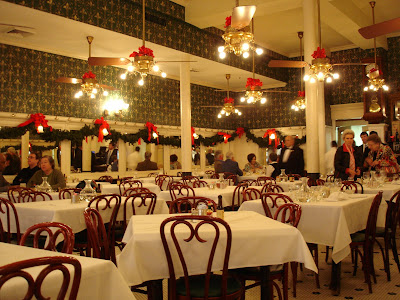
The first sign that something wasn't right was the fact that it took nearly 10 minutes for us to be greeted by our waiter, and when he
did finally vaporize he uttered hardly a word of apology and none of explanation (to be fair, I had not seen him milling about prior to his sudden appearance, and can only assume he was unaware he had been seated and was attending to some bathroom/phone/cigarette-smoking business in the back). I then asked for the server Robert had recommended to me, and was informed he was not there that day. Suddenly our service became helpful and attentive. They even gave us complimentary garlic bread.
For my meal, I chose to start with the gumbo (one of the many items on my list of must-tries). It was mildly spicy with a thick brown broth. As good as something you would order from a local diner and say, "That was pretty good." I then moved on to the Godchaux salad, a pile of iceberg lettuce topped with large, generous lumps of boiled shrimp, lump crabmeat, and a Creole mustard vinaigrette, topped with pinenuts and anchovies. The seafood was cooked well and all was served cold; the occasional remnant shell aside, I was satisfied with it. I then opted for the Poisson Meunière Amandine (rhymes with "bland"). To say I was disappointed would be a gross understatement. Greasy deep-fried flavorless fish with a handful of sliced almonds on top in a light (as in barely there) browned butter sauce (nothing else, just liquified butter). Bland. Boring. And really just not that appetizing.
In the meantime, we were surrounded by old, wealthy (and wasted) New Orleanians. We found out later that one
does not go to
Galatoire's for the food. One goes there for the
experience. It was confirmed that indeed their food
is not that good, but that people go there for the experience of going there (a "see and be seen" scene for old New Orleans families dating back generations). And also, if you ask for a menu, you are immediately targeted as one "not from around here" and are treated as such.
Had I known that I could have saved $120.00...or at least have put it towards a better meal.
Ah, but the wine list: of all the commendations they've received, this is the only one I can agree with. Pages and pages and pages of wines, with a heavy focus on French (some very old...some very expensive). The Big Five are all here: Latour, Lafite, Mouton, Margaux, and Petruce, all with their requisite $1,000+ price tags. Second to the French presence is Napa Valley, and all the big 'uns from that way (Opus One, etc.). But there is also a nice mix of Spanish, Chilean, Australian, and Argentinian wines, as well as some Italian heavy-hitters. While most are rather pricey, a discriminating wine drinker can still find a value. Just don't bother eating there.
After a foiled attempt to visit
Martinique Bistro, we ended up inside our very own hotel,
Bienville House, and the recently-relocated
Iris.
Iris was formerly located in a tiny house Uptown, and has since moved to this much-more-spacious location in the French Quarter. Initially they were a BYOB destination, but just in time for our arrival they now have a full bar and wine list. What began as a quick stop for coffee when it seemed every cafe in the city was closed ("This is New Orleans, no one gets coffee after noon") quickly morphed into a full meal.

And what a meal it was. In my early research I had come across some glowing reviews of this place and was excited to see it was located in our hotel; however, I assumed that I would shun this place in favor of more well-known, glitzier establishments and didn't think I would end up having my best meal of the trip on an utter whim at its polished oak bar.
We began with the Kaffir Lime Guacamole, made with mint and olive oil and served with root vegetable homemade chips. The guacamole was superb, with large chunks of tomatoes and a nice hint of garlic, but it was the root vegetable chips, perfectly salted and full of contrasting flavor, that made the dish.

Next up was the Rabbit Spring Rolls, served chilled with peanut sauce to dip. The dough used to wrap the rolls was so thin I could actually
see through it (an impressive feat to be able to work with what is surely such a difficult dough). Inside was all the typical carroty crunch of a spring roll (all raw), with tender, chilled rabbit meat to balance the bitters of cabbage and sprouts.

I then sampled the quail salad, served with a boiled quail egg, house-made vinaigrette, and shaved parmesan. The tiny quail legs were difficult to manage, but worth the extra effort. The salad itself was exploding with flavor, deceptively simple yet simply delectable.

From there I moved on to the Veal Cheek Ravioli, made with wild mushrooms, veal jus, parmesan, and cream. This was
amazing; the veal jus-cream sauce was rich and full of tangy condensed flavor, balanced perfectly with equally rich parmesan and slightly bitter mushrooms. The ravioli themselves were firm yet tender, with tender shreds of veal meal tucked inside. This is the kind of dish you don't so much eat as
savor, and I savored every drop of that decadent sauce.

My partner had a peppercorn-encrusted seared tuna, served with organic greens and a house-made balsamic vinaigrette. The tuna was seared to perfection and the peppercorn crust added flavor and kick; his only complaint was the excess of balsamic vinaigrette on the tuna (but I thought it was fine).

The wine list is still modest, but they do carry one of my favorites: Punto Final Malbec from Mendoza, Argentina. Mixologist Alan Walter also offers a host of specialty cocktails which utilize ingredients such as the locally-grown satsuma, sasafras tea, mint, and chicory. I guarantee that you have never seen a cocktail menu quite like this, which takes "creative" and mixes it with an upscale organic grocer. (See "Cold Snap": Brandy, Green Mangoes in White Balsamic Vinegar, Spiced Rum, Lemon, Proseco.)
Chef Ian Schnoebelen has achieved a masterfully playful and unique menu which fuses a variety of different culinary traditions in a light, clean presentation and atmosphere.
Iris wins in both food and ambiance, and the service is both personal and friendly. You feel like you're at the neighborhood deli but you're eating like you're at an exclusive California-style 5-star. Owners Schnoebelen and Laurie Casebonne will also happily come out and greet you, in between joking with their staff and ensuring that everything is being handled exactly how they wish it to be. Their approach is very hands-on, and it shows in all the personal touches and the welcoming environment.
On one of our server's recommendations, we then went to another New Orleans "institution," the revolving carousel bar inside the Hotel Monteleone. The
Carousel Piano Bar & Lounge slowly revolves, which can confuse patrons who have had a few too many and return from the bathroom to find their friends "gone." If you like Blackstone wine and butchered renditions of "Piano Man," this is the place for you. Note the sarcasm.
Day 2/Night 3: Cafe Beignet, Reginelli's, and Martinique BistroJust as we're starting the get the hang of it, we're already on our last hoorah.
We started the day at
Cafe Beignet, were I sampled another New Orleans "must"--the positively sinful beignet, a French-style pastry much like a doughnut served piping hot with powdered sugar, is a singular New Orleans experience. It is a soft, airy, pliable pastry with a slight crunch on the outside, light to the touch but heavy in the stomach. It's best to toss away all pre-conceived notions of "healthy dining" when in New Orleans, because the city's love of all that which is deep-fried and loaded with meat and dairy will do you in. Luckily, I am a lover of animal by-products, so I was in artery-clogging heaven.

Later we found ourselves in the Garden District on Magazine Street, and decided to stop in a place called
Reginelli's Pizzeria, a Louisiana pizza and sandwich chain. As much as I love pizza, it was the Baked Brie Calzone that caught my tongue, a mini calzone stuffed with ripe brie cheese.
Fab. They also have a great list of tasty pastas, salads, focaccia and pita sandwiches, and specialty pizzas. Their wine list was by the glass and presented on a printed list taped to a wine bottle on each table. Cute, and cheap. And once again, my Punto Final Malbec!

But that evening was what itI had been waiting for all along: experiencing
Réveillon in New Orleans.
Réveillon is a French dining tradition of a long dinner or party held on the evenings preceding Christmas and New Year's Days, which typically features foods of an exceptional or luxurious nature. A multitiude of New Orleans restaurants were participating in
Réveillon and offered special prix fixe menus throughout the season. There were, once again, a number that I was salivating over, but the one I ultimately decided on was
Martinique Bistro.
Chef de Cuisine Eric LaBouchere blends French and Caribbean cooking traditions with a dash of Italian heritage, making
Martinique Bistro a classically uncommon cross-cultural culinary tour as befits many New Orleans dining establishments. The interior is tiny and quaint, almost cottage-like, where the outdoor courtyard is lush and tropical. The servers are knowledgable and helpful, and won't rush you out even when you've stayed long past your welcome.

So why was I so fixated on this place above all other restaurants celebrating
Réveillon? One word: profiteroles.
We began with the Pork tenderloin Noisette "au Grillades" with poached hen's egg and Truffled Eggs with prosciutto in parmesan reggiano profiteroles. The pork tenderloin was tender and OMFG THE PROFITEROLES. They were ultimately the main reason I chose this restaurant and they were everything I wanted and hoped they would be and
more. A rich, thick, heavy parmesan cream sauce surrounded the airy profiterole. Black truffles and julienned prosciutto rounded out the flavor explosion of opulence and excess; the only thing I could have done without were the eggs themselves.


I was also able to sample Turtle soup with Amantillado sherry; it was spicy. The turtle meat was tender. Turtle meat is notoriously difficult to extract, and you must be careful where you venture to try the New Orleans traditional soup. This being my one and only experience with it, I think I picked a winner.

I also had the Belgian Endive with saffron and Riesling poached pears, candied walnuts, maytag bleu cheese, and white balsamic vinaigrette. Endive is exceedingly bitter and needs to be tempered with a lot of sweet and/or strong flavors; a dried berry would have suited this salad better than the understated poached pears, but the bleu cheese and walnuts worked wonders.

For our entrees, we selected the Crispy seared duck breast a la satsuma with a confit debris cassoulet cake and the Sauteed medallions of cervena venison with Poire Williams braised pears and a gingerbread demi-glace. I got my satsuma, but the duck was stringy and the cassoulet cake, a common French comfort food, was bland and a bit too "squishy" for my palate.

For dessert I had the Baked Alaska with chocolate cayenne ice cream, while my partner tried the sorbet sampler with flavors like Strawberry Banana, blueberry habanero, and mango mint. The house-made ice creams and sorbets are wonderful, popping with unexpected flavor combinations.


The setting is very romantic, especially when you're the last table on the patio. While not every dish was a winner, those that were so were
amazing.
The next morning saw us on a plane at 6:00AM, and so ends my culinary tour of the Bayou. I thank Robert Peyton for his suggestions, and look forward to being able to be as leisurely as the locals the next time around.


