There’s one thing you should know before walking into one of Southwest Detroit’s many neighborhood watering holes: you’re going to drink way more than you planned. “What are you drinking?” is the greeting of choice at these establishments, and even if it’s your first time visiting -- and they’ll be able to tell, because these are the kind of joints where an unfamiliar face is noticed immediately -- you’re only a stranger your first time.
Read more.

Showing posts with label neighborhood bars. Show all posts
Showing posts with label neighborhood bars. Show all posts
Wednesday, March 13, 2013
Monday, February 11, 2013
[Real Detroit Weekly] Anchor Bar
 |
| Photo by Nicole Rupersburg. |
Lately Detroit has become known for the sort of see-and-be-seen bar scenes that appeal to the would-be Brooklynite trendophiles. And we love them! We love these craft beer bars and craft cocktail bars and anything else with the word "craft" in it. But sometimes you want to go ... well, where everybody knows your name, and also where you don't feel like you need to have a distiller-level knowledge of bourbon just to fit in.
Anchor Bar is that place. A family-owned business for over 50 years (with 20 years in the same location in downtown Detroit), Anchor Bar is that neighborhood place you always go back to no matter how many times you might stray. Sure, we all get tempted by those flashy new joints with their witty drink names and their architecturally-interesting repurposed furniture built from salvaged industrial materials. But sometimes we just want to go somewhere homey.
Read more.

Wednesday, June 20, 2012
[EID Feature] Gimme, Gimme, Gimme the Honky Tonk Tacos: Imperial
 |
| Photo by Nicole Rupersburg. All other photos from Imperial. |
From the very beginning, owner Jeff King has insisted that Imperial is “a community bar with a taco truck on the back, not a Mexican restaurant.” He has insisted that people don’t think of it as a restaurant, but as a bar … with a taco truck on the back (“truck” being, you know, a kitchen).
People pretty instinctively started to refer to this place as “that new Mexican restaurant in Ferndale.” I mean, it’s in a building that was totally worked over from the previous tenant (the Post Bar, if you care). Despite King’s comments, the presence of a full kitchen and absence of an actual truck made people think more “restaurant,” less what he said. It’s definitely a bar, but they serve food, so therefore restaurant.
Except that … no, it’s a bar. With, well … a taco truck on the back (if only in spirit rather than semantics).
 |
| Salt & pepper grilled pork belly w/apple, jicama & jalapeño slaw, cilantro & onion |
I noted before that the place is California dreamin’ in the midst of Detroit realties, and that’s really the best way to describe this place. Or perhaps another friend’s description is a little more on-point: “…it’s well-designed, plays drunken alt country, [has] tons of good booze and the bartenders are all tatted-up badasses.” Pretty much.
The space is sparse but slick: tons of natural light and warm breezes come pouring through the garage doors; the booths, tables and floors are all light wood with breezy appeal; the centerpiece of the solid wood back-lit bar is a painting of Johnny Cash flashing his middle finger. It is, and stay with me here, Memphis rockabilly meets hipster L.A. in the way that a lot of people say something is “so L.A.” except that it actually is so L.A. There are community tables, plenty of bar stools and a patio out back. It feels like motorcycles and cigarettes, skinny jeans and cowboy hats, bourbon and blues, hipster and honky tonk, designer and dive.
There are no PBR light-up signs, no Corona mirrors or Miller Lite banners. King says, “I love all of that about a bar but what we’re trying to do is not the status quo. When you think of a ‘neighborhood bar’ you think of that place your grandpa went to … [I want it to feel like that] but not look it. I want it to feel like it’s been here 75 years with a little honky tonk vibe.”

It is correct that they have no taps and no bar guns. It is also correct that they have an extensive selection of tequilas and bourbons, and they also have a few key labels to cater to the craft beer crowd (who’s really gonna say no to AXL Pale Ale?). It is additionally correct that while they do not cater to the craft cocktail crowd, they still mix a mean drink (try the Mezcal Buck) and use all fresh house-made ingredients.
They serve what King calls “L.A.-style street vendor tacos.” No hard shells, no hamburger, no sour cream, no shredded cheese. They make everything from scratch in-house right down to the salsas. “Consistency and quality is a focus,” says King. “It’s all very affordable, [made by a chef] and all fresh, all authentic L.A.-style.”
Chef Brennan Calnin went to culinary school at Kendall College in Chicago then worked in Chicago (under Takashi Yagihashi) then in Milwaukee under a three-time James Beard-nominated chef, then as a private chef on a ranch for a Wall Street president, then under Eric Patterson at the Cook’s House in Traverse City … as King jokes, “This ain’t no line cook.” Through his relationships at the Cook’s House Calnin was connected with one of the other partners at Imperial. “It was a no-brainer to jump on board,” he says.
 |
| Carne Asada - marinated steak, red pepper salsa |
“I really like the idea of a limited menu because I feel like you’re not spreading yourself thin trying to do a bunch of things,” Calnin explains. “You have the idea you’re trying to get across and [you can] do it very well. It ends up promoting consistency.”
Calnin and King are both very passionate about providing high-quality from-scratch foods made with fresh, locally-sourced ingredients. “Tacos are such an ingredient-driven food and Michigan has so many things to use locally,” says Calnin. “It’s really important [to us] to forge relationships with local farmers … it’s so important for so many reasons,” including the economy and ecology. “We have all these great things – tomatoes and peppers and sweet corn and chicken and eggs and beef and lamb and goat – right here in our backyard.”
 |
| Elote Especial - Grilled sweet corn, poblano lime cream, cotija cheese and chilies |
Eventually they want to have their own mobile truck prowling the streets so the whole “taco truck” joke will become a reality. “We really like the idea of mobile vendors and street vendors,” King comments.
For right now they’re just focused on running the bar in the midst of all the huge opening buzz and the tremendously positive reception they’ve received so far. They’re open seven days a week from 11 a.m. to 2 a.m. (the kitchen closes a bit earlier but plans are to have it eventually be open as long as the bar).

Wednesday, May 16, 2012
[HOT LIST] Prohibition bars
 |
| Two Way Inn. Photo by Nicole Rupersburg. |
There is a certain amount of Prohibition-era romanticization happening lately with all the new craft cocktail bars around town looking to be throwbacks to the era. (The Sugar House and the Oakland even take their names from the notorious Purple Gang, the biggest Prohibition bootleggers in the country that were based right here in Detroit.) As much as we love these new bars (and for the love of bourbon and bitters we really truly do), we also love an honest-to-God-and-guns dive bar. These places are the real deal: century-old bars tucked away in residential neighborhoods (each grandfathered in as zoning laws were introduced) that operated as bonafide blind pigs during the days of Prohibition and are still slinging drinks to this day.
#1 Two Way Inn (Detroit)
Many bars claim to be the "oldest bar in Detroit," and probably many of them can fairly lay claim to the title when you factor in shades of difference such as "oldest continuously-operated bar" and "oldest family-owned bar." The Two Way Inn, open since 1876, is one of those bars. Over the course of its lifetime it has been a hotel, brothel, jail, general store, blind pig and bar. Now it's just a damn cool place to hang out. The family that owns it live upstairs and it has exactly that kind of family-atmosphere: stopping in is like dropping by your aunt's house and hanging with your cousins. They have parties and host BBQs and pub crawls, but even if there's no special event going on, the Two Way is the kind of place you can always stop in for a beer (they have Zywiec, aka Polish PBR) and end up doing shots of Jerzy (Polish Jaeger) with the new friends you just made. There's a velvet painting on John Wayne on the wall and they have WiFi (hel-lo new office!). Things to note: you have to be buzzed in through the front door (which is just cool) and it's cash only. Oh, and also, it's haunted.
 |
| Photo from Hour Detroit. |
Located in the basement of an old farmhouse on the outskirts of Mt. Clemens (one of metro Detroit's oldest cities), East Side Tavern feels the most like the century-old bar (and former blind pig) that it is. This place is practically a living room, just with a bar instead of a couch. In fact, it's about the size of one, and the ceiling is so low that even at 5'6'' I felt the need to duck. They like to say, “You’re only a stranger here once," and plenty of would-be “friendly neighborhood joints” claim the same, but this is the kind of place where it’s absolutely true. The bartender knows everyone by name, and if she doesn’t know you, you’ll get introduced into the conversation pretty quickly. (Owner Frank DeBruyn, a 76-year-old who jokes about having a bar in his basement, is usually hanging out too.) Once you get past the novelty of this tiny place in this unexpected location, this is simply a great dive bar chill spot where you can go shoot the shit with the natives and eat (no joke) one of the best burgers you've ever had in your life.
#3 Ye Olde Tap Room (Detroit)
Built in the 1800s as a trolley repair station and operating as a bar since 1912, the Tap Room is a Detroit favorite both for the vibe and for the beer and whiskey - 285 beer labels all total (and some really cool stuff too, both American craft and imports) and an extensive selection of single malt scotches and whiskeys. This is a beer and shot place, but fancy beer and fancy shots (though they do sell plenty of Jameson shots with PBR backs). Despite the impressive selection, there's nothing snooty or pompous about this place. The bartenders are some of the coolest and the customers are a good mix of area locals and workers, Detroit scenesters and hipsters, and beeries from near and far. They also just celebrated their annual Prohibition Party (which, admittedly, was the impetus for this list), and were known as one of the Purple Gang's haunts (the basement was a speakeasy). And they have darts, some cool live bands, and an awesome patio in the summer.
#4 The Gold Star (Wyandotte)
Established in 1923, the Gold Star (in Wyandotte's Polish center) is in an old farmhouse smack-dab in the middle of the neighborhood. To give some perspective here, Wyandotte was once in the Guinness Book of World Records for having the most churches and bars per square mile of any city in the world (blame the predominant Polish-Catholic roots for their love of God and beer). The Gold Star hearkens back to the day when bars were part of the neighborhood and people could walk to them, and is still very much a local neighborhood hangout. It still has the dirt wall basement that was a speakeasy during Prohibition, and is said to be haunted after a tragic fire that killed four children (it was also the family home). The Bozymowski family, who were the original owners and ran the place for decades, no longer own the bar but you can still stop in and say hi to Val, granddaughter of the original owners who still runs the show. Plus they've got $1 drafts and $5 pitchers all day every day and free pool on Sundays. (Cash only.)
#5 Whiskey in the Jar (Hamtramck)
Whiskey is kind of an infamous Hamtramck hangout that attracts the die-hard bar flies, Hamtramck crust punks, old Poles and Detroit drunks in equal quantities. Everyone knows to go here every time there is a drinking high holiday held in Hamtramck (and there's one pretty much every month), but even in downtime this place is great dive bar hangout. Once a speakeasy, it's now part of the Blowout circuit and is easily one of Hamtramck's most popular bars (and there are many). Sidle up to the bar for some socializing with strangers, and if it's your first time in you have to do a shot of Jerzy. (Seriously. They make you.)
Bubbling under Stonehouse Bar (Detroit), Abick's Bar (Detroit), Tom's Tavern (Detroit), Jacoby's German Biergarten (Detroit), Kovacs Bar (Southwest Detroit), Nancy Whiskey (Detroit), New Dodge Lounge (Hamtramck)
Note: Places like Cliff Bell's, Foran's Grand Trunk Pub, and the Dakota Inn Rathskeller, while all old themselves, did not open as bars until after the end of Prohibition (1933, 1933 and 1935, respectively).
Saturday, March 24, 2012
[EID Preview] The Legend of Green Dot Stables
 |
| All photos by Nicole Rupersburg. |
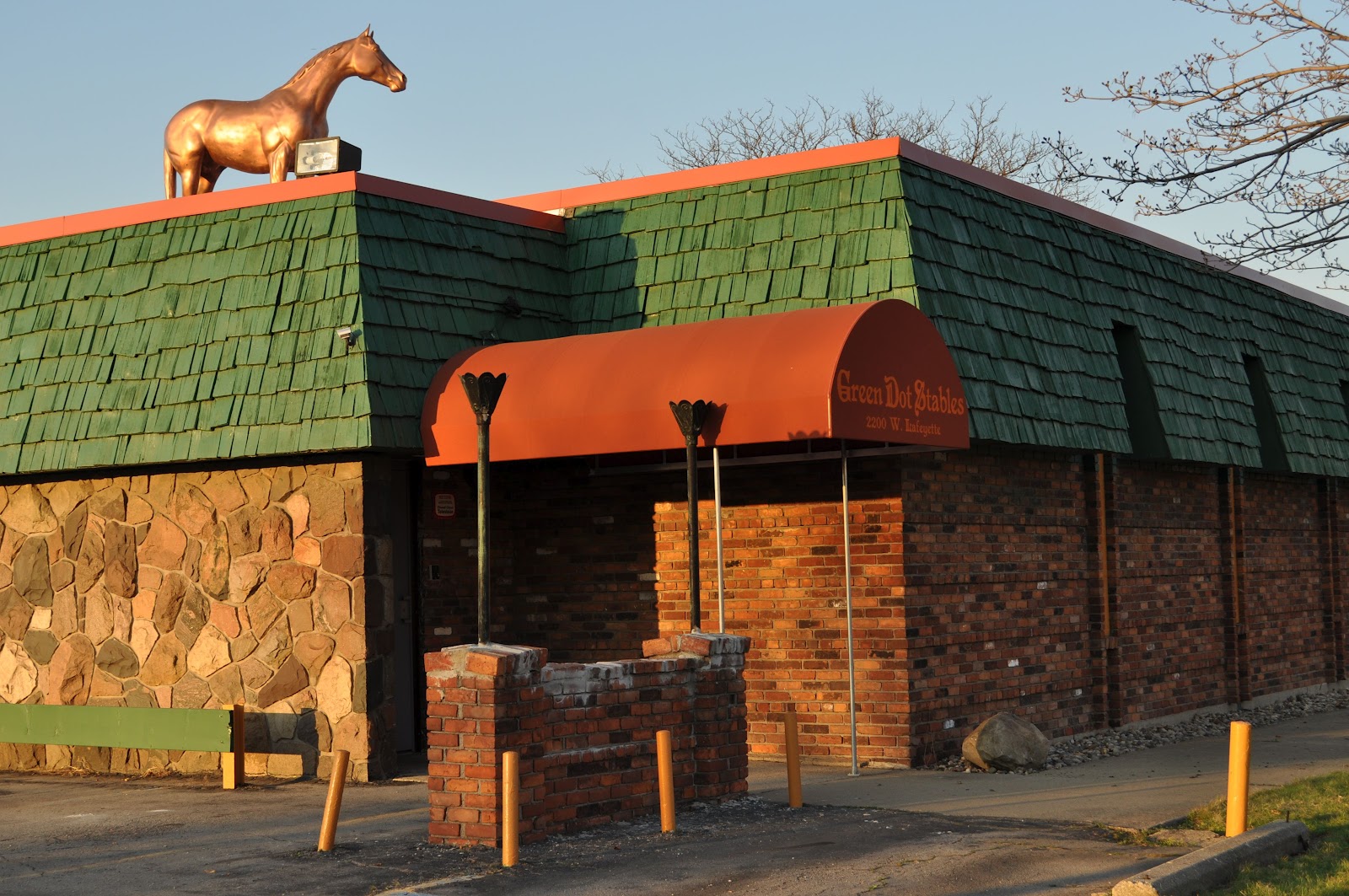
Local legend has it that Green Dot Stables in “Corktown Shores” was opened by a former horseracing jockey – hence the equestrian theme. But the actual history of the place is shrouded in mystery. (Ooooooooh…)
Owner Jacques Driscoll admits they haven’t actually been able to find any reliable information about the bar’s history (and why it has that unique, if entirely inexplicable, equestrian theme). There’s plenty of third-party hearsay available: Jacques heard that the original owner of the building (built in 1970) owned his own horse stables which he called Green Dot and the bar was named after them. (He heard this from a guy he met who claimed to know the original owner’s son.) Chef Les Molnar also heard that there was a guy who owned a bar in Southwest Detroit called Joey’s Green Parrot in the ‘50s and ‘60s, and that that guy was really into horses and his son originally owned the building. (This he heard from his aunt who worked at Joey’s Green Parrot when she was 17.)
Green Dot Stables seems to be a favorite focal point of local lore. Before it closed last year, people “in the know” knew that this was a popular cop hangout that regularly stayed open serving drinks well past 5 a.m.

While we may never know the true history of the Green Dot Stables – it will go down as another unsolved mystery in Detroit's history, much like where Jimmy Hoffa is buried (WHAT IF JIMMY HOFFA IS BURIED IN GREEN DOT???) – the good news is that the new owners have retained that odd equestrian motif and have stayed true to the name “Green Dot Stables.”
“When we learned about the history of the place we wanted to keep the tradition,” Jacques explains. “We wanted it to have the same look and feel with a clean, modern look to it. But we wanted to keep the history and the heritage; [the space is] so conducive [to it] and everything has that feeling already so trying to change it [didn’t make any sense]." Jacques’s wife Christine Driscoll adds, “We wanted it to have the same feel, just polished.”
The Driscolls are a very young couple originally from Detroit. They were living in California but moved back because they saw an opportunity to do something here they never would have been able to do in San Diego.

They acquired the building 8 months ago and began the extensive process of cleaning and refinishing (many years’ worth of cigarette smoke had to be scrubbed away). They kept a lot of the old materials, like the original chairs that look like they belong in a poker room and the faux-granite formica bar and phone booth (which will hold all of their beer and wine to-go). They also added a lot of their own touches to enhance the theme – the footrail of the bar is covered with old horse racing tickets they found on eBay; the hallway to the bathrooms is covered in a horse-themed mural (with newspaper clippings on old Detroit jockeys) done by local artist Jonathan Ryan Rajewski; the walls are adorned with canvas-mounted photographs taken by their friend and local photographer Ara Howrani (who was given access to the track at Northville Downs to take these photos); velvet curtains were made by Detroit designer and seamstress extraordinaire Sarah Lapinski.

Having moved back home to Detroit after living in San Diego, Jacques got to experience what it means to open a business in the city and have the whole community rally around it. “Jacques’s vision for leaving San Diego was knowing that he couldn’t [open a restaurant there],” Les says. “And I couldn’t do it in Chicago. The community here is incredible; everybody helps. People were coming in doing physical labor; we did not expect it to go the way it did.” Les says every time they would mention that they needed something, someone knew somebody who’d be willing to do it for beer. “We just didn’t expect that. Everyone was really helpful.” Another friend did their logo, and right now an artist at OmniCorp Detroit is designing a bike rack shaped like a horse for them. “Everything in this place has a story like that,” Jacques says.
Jacques has wanted to open a restaurant ever since high school and he started to develop his concept while he and Christine were still living in California. Originally he wanted to serve California-style tacos but the concept evolved once they acquired the building (which is awfully close to Southwest and its many taquerias) and brought Les on board.
Les attended Le Cordon Bleu College of Culinary Arts in Chicago and worked in several Chicago restaurants and as a private chef in Lake Geneva before ending up back in Detroit. He was working at Town Tavern before he connected with Jacques, then spent some of the intermittent time working at Roast waiting for Green Dot to open (the old “trying to get a liquor license in Detroit” story once again). “That was hard to leave,” he says. “I felt like, ‘This is why I went to culinary school.’ But at the end of the day doing my own food and having my own kitchen meant more to me. I really believe in Jacques and Christine as a whole and in the company; I see a lot of potential here.”

The whole team wants Green Dot to be a food place first and have great beer and liquor prices as well. One of the biggest renovations they did was completely overhauling the kitchen, and they have been planning the menu for months. They are making everything from scratch that they can with a lot of focus on maintaining low price points. Everything on the menu will be $2-3 with no additional tax. All domestic beers and well drinks will be $2; all craft beers and premium drinks $3. (And their craft beer selection will include labels like Dragonmead’s Final Absolution. “Where else can you get Final Absolution for $3?” Jacques asks. The answer, of course, is nowhere.)
They’re also very passionate about sourcing high-quality products. “It’s such a minimal price increment to buy quality food,” Jacques explains. “Just upgrade a little – that’s one of our philosophies.” They’re also using a lot of quality local products like kimchi and kraut from the Brinery in Ann Arbor and cheese curds from Oliver Farms for their poutine.

But the real focus at Green Dot is on sliders. Not wimpy slivers of beef patty slathered in ketchup, mustard and onions on soggy buns that you get at places like Hunter House; exciting sliders like the “Au Poivre” made with beef, peppercorns and cognac aioli; and the “Hot Brown” made with chicken, bacon and mornay sauce (inspired by a sandwich that originated with the Kentucky Derby). Because the price points are so low (seriously, $2-3 each) they hope that diners will be more willing to experiment with unfamiliar dishes, like the “Mystery Meat” slider which will be a rotating selection that might be rabbit, elk, tongue or other wild game or offal. “It’s at a price point you won’t feel bad for spending,” Jacques notes. They’re also serving seven different kinds of fries (POUTINE!), a slightly spicy mac and cheese made with mornay sauce and red pepper flakes, and venison chili on their chili cheese fries and Coney slider.
The plan is to serve food late so that this can be a place for other chefs and restaurant industry people to come after work and enjoy a good meal. “We want to cater to the industry crowd so they have some place to eat that is not a Coney,” Les says. “We want it to be kind of known as a late-night place.” Just not quite as late-night as it used to be, anyway. (According to legend, that is.)

They are ready to open but are still awaiting their liquor license approval from the city (stop me if you’ve heard this one before), but starting next week they will be open serving lunch from 11 a.m. to 3 p.m. “It’s a blessing we’re doing lunch first so we can work out all the kinks instead of going full force into it,” Jacques says. But people also tend to be very understanding, especially in Detroit where people are all too familiar with the obstacles involved in opening a business. “If you have good food, good service and a good atmosphere, all the other shit can hit the fan and people will understand anything else,” Les jokes. They hope to be fully open in a month.
Want to see more? View the Flickr set here.

Saturday, March 10, 2012
[Metromode] Great Neighborhood Bars
 |
| The burger at East Side Tavern. |
What defines a "neighborhood bar"? Is it that sense of belonging? The desire to go to a place "where everybody knows your name"? Is it a bar unique to its time and place in history, or is it defined by its patrons and surroundings? Is it a bar you can easily stumble home from or a place that reflects the unique identity of the neighborhood itself?
A neighborhood bar is any and all of those things. It isn't the assembly line sports bar with 50 flat screen TVs and enough flashing lights to induce an epileptic seizure. Nor is it a glammed-up joint with "see-and-be-seen" people in black flashing duck faces for Facebook photos. A neighborhood bar tends to avoids trends, is perhaps a bit off the beaten path, swarming with locals, and above all else comfortable and welcoming. There is a certain level of dive bar je ne sais pas quoi appeal. These places can be over 100 years old or barely opened a year. What defines a neighborhood bar is not the number of people who have reviewed it on Yelp but the crowd of local regulars that keep it vibrant, making it their second living room.
Neighborhood bars in the truest sense proliferate throughout Detroit. These are the bars located in predominantly residential neighborhoods, bars that existed before there was such a thing as zoning, bars that are located in houses right next to the very same houses where its patrons live.
Read more.
Subscribe to:
Posts (Atom)